
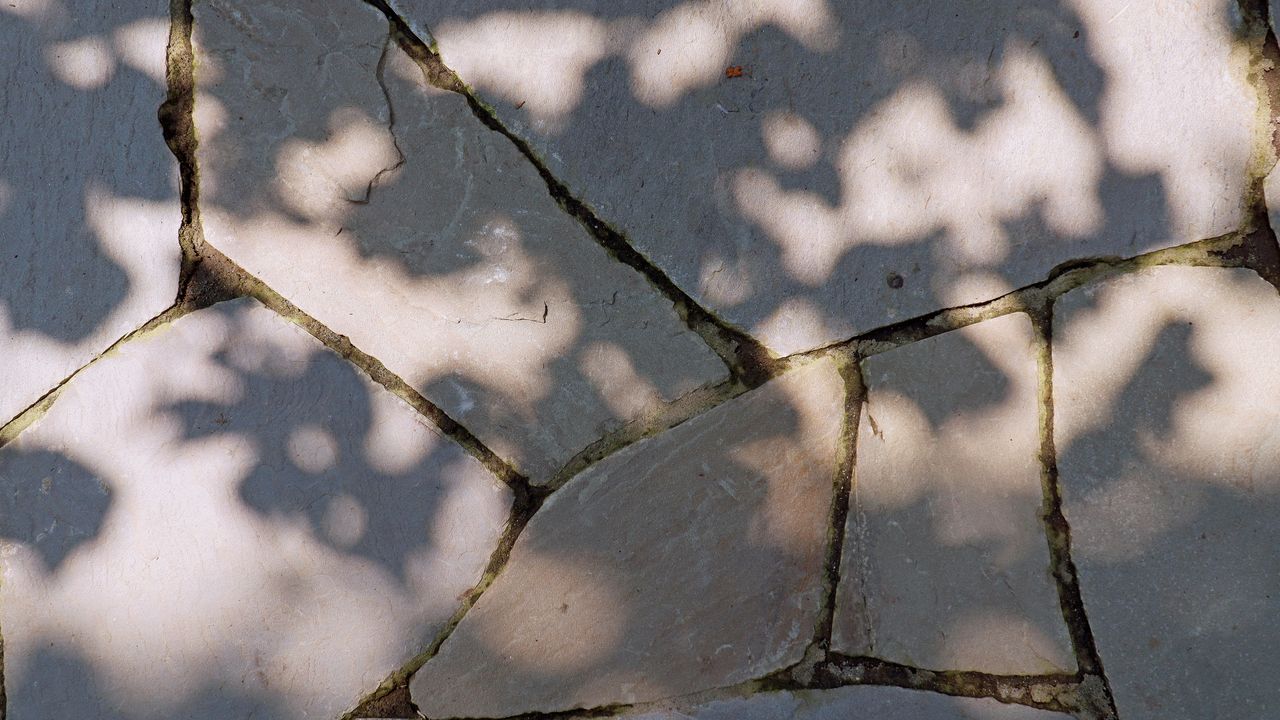
There was a time when you couldn’t walk through a British garden without encountering it: irregular slabs fitted together in a seemingly random pattern, usually in shades of grey, occasionally softened by moss and almost invariably accompanied by a strip of lawn.
Crazy-paving was once a staple of British patios and paths. Then, rather suddenly, it seemed to disappear. Straight lines, geometric paving and carefully planned outdoor spaces took over. But was crazy-paving really banished from the garden forever?
From Practical to Fashionable
Crazy-paving was never entirely about aesthetics. Its popularity was partly practical. Irregular pieces of stone or concrete could be fitted together to create paths, patios and other hard surfaces without requiring the precision associated with formal paving.
For generations of homeowners, it was simply part of the visual language of the British garden.
The style became particularly familiar during the post-war decades, when improving outdoor spaces was often about making them functional and relatively inexpensive. A crazy-paved patio could provide somewhere to sit, somewhere to dry washing and somewhere for children to play.
It was practical, familiar and distinctly suburban.
Then Garden Design Changed
Garden design gradually became more influenced by ideas of outdoor rooms, architectural landscaping and cleaner lines. Large-format paving became popular, along with porcelain tiles, contemporary decking and carefully designed planting schemes.
Suddenly, the irregularity that had once made crazy-paving appealing could look dated.
The name itself probably didn’t help. “Crazy-paving” sounds charmingly eccentric, but it also suggests something improvised rather than deliberately designed.
Modern garden design tends to favour repetition, symmetry and clear visual structure. Rectangular slabs laid in precise patterns fit neatly into that aesthetic.
But Crazy-Paving Hasn’t Really Gone Away
Look more closely at contemporary gardens and you can see that the basic idea has survived. Irregular stone is still used extensively, particularly in naturalistic gardens and traditional landscapes.
The difference is often in the material and the execution.
Modern irregular paving might use natural stone with carefully selected colours and textures. Rather than being surrounded by a sea of concrete, it might be combined with gravel, planting, groundcover or even grass.
The result can feel considerably more intentional than the crazy-paved patios of the past.
The Return of the Imperfect Garden
There is also a broader shift in garden design towards natural materials and less rigid spaces. Not every garden needs to look as though it has been drawn with a ruler.
Irregular stone can work particularly well in cottage-style gardens, wildlife-friendly spaces and designs intended to feel established rather than newly installed.
There is something appealing about paving that doesn’t demand perfection. Slight variations in shape, colour and texture can make a garden feel older and more connected to its surroundings.
Could Crazy-Paving Become Cool Again?
Perhaps it already has — although it may have undergone a rebranding exercise.
Today’s version is less likely to involve randomly assembled concrete slabs and more likely to feature reclaimed stone, natural textures and thoughtful planting. The principle is similar, but the execution is considerably more sophisticated.
And that raises an interesting question about garden trends generally. How many supposedly outdated ideas are actually perfectly good ideas that simply fell out of fashion?
Crazy-paving may have disappeared from many modern suburban gardens, but its underlying appeal — using irregular materials to create an informal, characterful outdoor space — is arguably more relevant than ever.
Old Ideas Can Have Another Life
Garden fashions come and go. The formal lawns of one generation become the wildlife gardens of another, while materials that were once considered old-fashioned eventually return with a new aesthetic attached to them.
So perhaps we shouldn’t write off crazy-paving just yet.
You might not want the classic 1970s patio outside your back door. But a carefully designed path using irregular reclaimed stone, softened with planting and allowed to weather naturally? That sounds considerably less crazy.
Featured image credit: by John Foster Rossi via Pexels.